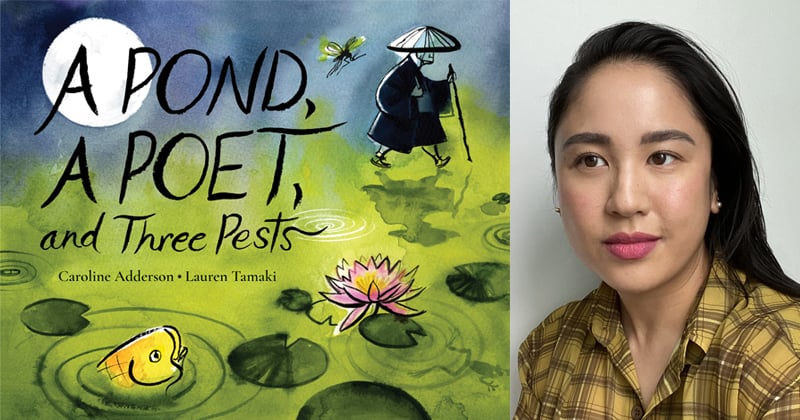
Lauren Tamaki is a designer, writer, and award-winning illustrator. Her work includes Seen and Unseen: What Dorothea Lange, Toyo Miyatake, and Ansel Adams’s Photographs Reveal About the Japanese American Incarceration, which received a Sibert Informational Book Medal, and Every Peach Is a Story. Her latest picture book, A Pond, a Poet, and Three Pests (Groundwood Books, out now) is inspired by the famous Japanese haiku “The Old Pond,” by Bashō.


What sparked your interest in illustration?
There was never a time when drawing wasn’t in my life, and there was never a time when I didn’t think this is what I wanted to do. I have a degree in fashion design, and I’ve worked at the National Ballet as a stitcher, so I’ve done a lot of other things. But in the back of my mind, I always knew I wanted to be an illustrator, I wanted to draw children’s books. At this point in my career, I’m fulfilling that goal of being a children’s book illustrator.
Who or what has been a major influence on your illustrating style?
It’s an amalgamation of so many influences. I’ve always been attracted to the really crisp line, and making the line emotional like Quentin Blake and William Steig. I grew up reading Mad magazine, and the work of Jim Davis. And then after art school, I discovered artists such as Alice Neel and Elizabeth Catlett. Catlett was a multidisciplinary artist: she worked in sculpture, she did screen prints, and she did drawings. I started to see there’s no limit to what you can do.
When a project such as A Pond, a Poet, and Three Pests crosses your desk, where do you begin?
Every book is so different, but what grounds me is research, no matter what the subject. I go to the Toronto Public Library and take out as many books as I can on the subject. If I can’t take them out, I’ll seek them out in a bookstore. I probably research for too long. I get a really big sketchbook where I can funnel all of the ideas, thoughts, and random things that I’ve picked up. Then, as I write more notes, I paste them on a printout of the actual manuscript, because I have to see things physically laid out in front of me.
Can you take us through the process of illustrating a page from the book?
For this book, on first reading I was struck by the characters. I could see them clearly in my mind. When I read it the second time, I realized, “Oh, it’s at night.” So, if it’s at night and it’s a Japanese story, I kind of want an inkiness, I want an indigo colour. The editor, Karen Li, said she wanted a pond that was slimy and overgrown. We have the night and we have the pond. So, there’s indigo and slime green, and I knew I didn’t want to deviate too far from the limited palette, because it was also a challenge for me.
I love to punish myself, and think, “How can I challenge myself and try something completely new?” It’s never completely new, because I’m using the same medium I used in my previous book (Every Peach Is a Story): acrylic ink. This particular book, however, is only paint. I wanted it to feel immersive and moody, and that’s not something I’ve tried before.
Do you think you will ever step away from acrylics and ink to try something different?
I would love to do a book in pencil. My two favourite teachers at art school said, “Your first love is pencil. So, of course, that’s what you’re going to be comfortable with.” That’s what you pick up when you’re a kid, a pencil. And I’ve never gotten over that feeling. I do all my sketches in pencil for anything editorial. That’s my comfort zone. Even though I love drawing in pencil, I always think, for some reason, it’s just for the sketching phase. But sometimes those drawings are better than the finals, and I want to investigate that.
What do you hope young readers take away from the book?
I think the book is about the nature of inspiration. You don’t have to pay attention to the loudest thing; you can pay attention to the smallest thing. You don’t have to go with the flow of the crowd; you can see what’s over here, see what’s behind this shelf. Letting inspiration get you wherever it is. I love that aspect of the book.
On a visceral level, I want kids to think, “Oh, that’s funny.” Something I’ve noticed since I’ve been making books for kids, talking with kids, reading to kids is I love when they’re laughing.
What do you do to nurture your passion for illustration?
It all feeds into each other, even my fashion design degree and my love of costume. Lately it’s been a lot of movies, specifically Robert Altman’s Criterion Collection. I’ve always loved movies, but I’ve been kind of ramping it up, and it has been so deeply inspiring. If you’re feeling stuck, watch an amazing movie: watch how the cinematographer sets up a shot, how the movie introduces a character, how the stage is set up, look at the establishing shots. It’s all storytelling, and that’s really exciting for me. Also, I decided to get into ceramics. I have found such a great community there and such an exchange of ideas.
If you could illustrate any classic children’s book, which would it be?
I have been trying to decolonize, but what you read as a kid sticks with you, and what immediately comes to mind is a King Arthur story. Recently, I’ve been reading more Japanese folk tales, trying to get past my Western education, and I would love to do a collection of Japanese folk tales, because they’re so deeply strange and fantastical – they have fabulous characters, and everybody acts terribly.
This interview has been edited and condensed.
Read Q+As with Miki Sato and Nahid Kazemi.




 Contact us via email