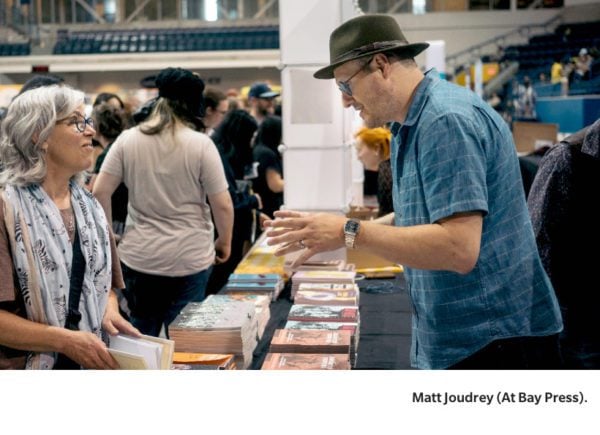
Matt Joudrey, the publisher of At Bay Press, has been lamenting the state of Canadian publishing from his base in the vibrant indie publishing community of Winnipeg. Joudrey and his wife, managing editor Alana Brooker, moved At Bay’s operations from Toronto to Manitoba in 2010, two years after founding the press. The diverse publishing environment that includes ARP Books, Fernwood Publishing, Great Plains Press, Portage & Main Press, Turnstone Press, Griots Lounge Publishing Canada, and University of Manitoba Press proved far too attractive to ignore.
Membership in the Association of Manitoba Book Publishers, an advocacy group that raises awareness about issues such as copyright reform, foreign ownership in the publishing industry, and economic stability in the arts, provides Joudrey with camaraderie and support. It is a point of pride for Joudrey that Manitoba publishers are staunchly united in the belief that human rights and reconciliation must remain at the forefront of their publishing activities.
At Bay Press takes its name from a Will Eisner The Spirit comic strip entitled “Fox at Bay.” Joudrey says that the tale of a cornered criminal felt like an apt metaphor for what happens when you paint a creative into a corner: they bare their teeth. Now in its 18th year, At Bay publishes 20 titles annually; the list includes nonfiction, fiction, graphic novels, poetry, and even abstract photography books.
The literary press first received international attention when they released Woman: An Anthology in 2014, which featured contributions from Stephen King, Alice Munro, Emma LaRocque, and Van Kunder about the unique voicing used to portray women in literature. The book went on to win the IPPY Outstanding Book of the Year Independent Spirit Award, and the press donated all the proceeds from sales of the book to breast cancer research.
In June, At Bay released Ian Thornton’s biography of Anonymous hacktivist Commander X, My Year of Living Anonymously. Joudrey is a lifelong fan of serial format comic “floppies” and original graphic novels, the latter of which the press has published in significant number; this spring they published Danila Botha’s Vidal and in September, they will launch Wild Dogs and Fat Babies, Tamara Bond’s graphic memoir about her lifelong struggle with schizoaffective disorder.
Joudrey believes that the sheer range of titles that At Bay publishes is the key to their longevity. It is also, he emphasizes, the solution to Canadian publishing’s retreat into “zeitgeist-tapping” acquisitions.
“We are after things that have absolutely nothing to do with the zeitgeist,” he says, touting At Bay’s extensive backlist. “We want to turn over stones and see what’s crawling underneath them – to discover new voices, new identities, new thoughts.”
The majority of their publishing springs from unsolicited submissions – 85 per cent of the monthly average of 75 submissions come from unrepresented authors using the CanSubmit system.
“Indie publishing is doing some of the most exciting literary work today,” Joudrey says. “I don’t even think the multinationals would refute that. But they’re infamous for waiting until an indie author wins a big award and then scooping them up. They’re hanging out in that dark alley waiting for you to walk by.”
Joudrey does not begrudge authors who wish to take this road, even if he’d prefer that they continue working with the independent presses who nurtured their early careers. He recognizes that a writer’s goal is to have a viable writing practice, and that until the existing publishing paradigm changes, presses like At Bay will be lost in a “vicious cycle of taking risks on authors only to lose them when something big happens to them.”
“One of the things that breaks my heart,” Joudrey continues, “is that if you walk into a bookstore, whether it’s a chain or independent, 90 per cent of what’s on the shelves are books published by multinationals. Booksellers need to stop looking at multinationals as the only way to keep their lights on.”
Joudrey, who is the author of several books, including Marmalade Parade (Guernica Editions, 2026), believes that if book shelf real estate for “eye-opening” independent books were to increase significantly, there would be a shift in reader spending habits based on exposure alone.
These disadvantages are only made worse by the glacial pace that money circulates in publishing, Joudrey notes.
“My designers, editors, and writers deserve to be paid three times as much as what I’m paying,” Joudrey says. “There’s only so long that passion will carry you forward before people get out of publishing altogether.”
Despite Joudrey’s grim assessment of the difficulties faced by Canadian-owned publishers, he does not believe that he is being cynical. On the contrary, he believes that the solutions to the problems he’s described are right under everyone’s noses.
“The change needs to begin at two levels,” Joudrey says. “Governments need to reform copyright law and recognize that a creator’s work needs to not only be created but saved. Current copyright laws leave authors’ work desperately exposed and rampant pirating is widely exploited. The author deserves protection, and the nation deserves the cultural stability that results from it.”
Joudrey’s second recommendation may be heterodox, but on this point he cannot be any clearer.
“We need to do away with bookseller returns,” Joudrey says. “My nightmare is seeing 1,000 books ordered by one bookstore because I know 995 will be returned. What I would prefer is to have 1,000 different bookstores ordering one copy each. If they sell that one book and it’s replenishable, you’ll see it come back in stock.”
“At first, the author will probably see lower royalties, but you are going to see this burgeoning foundation built. I don’t think everyone will agree with me, but I do believe that on the bookselling side, books by independent publishers need immediate front-line support.”
Joudrey’s final thoughts turn to writers and the respect their work deserves. “An author deserves a living wage and to be able to afford all the regular things people need to lead a healthy, normal life,” Joudrey says. “I really don’t believe that everybody can be a writer. Their brains just work in a different way. They’re focused on their craft, and they’re always building themselves or constantly evolving. Once you recognize this, you begin to understand the value that the writer both deserves and represents culturally to a region, to a territory, to the world.”




 Contact us via email