For twenty years, Bev had collaborated with Sally to massage her manuscripts into the bound books they would become. As an editor, Bev loved everything about the process—from working on the manuscript with the author, to writing promotional copy, to proofreading and consulting with the designer on cover concepts. Finally, two years after reading a manuscript’s first sentence, she’d open the box of books in the publisher’s warehouse, lift out the first copy, and hold it tenderly in her hands. It was better than Christmas, and it never got old.
Bev had been thirty-three when she first edited one of Sally’s manuscripts. Now, there was a sacred trust, and a bond, between author and editor. And a certain shorthand.
When the phone rang in her bungalow, she hurried to search for it. “I just heard,” said Bev breathlessly, after finding the phone buried on her desk under a pile of papers. “Congratulations! This is big!”
“I won’t win,” said Sally, her voice flat. “Hang on, I have to adjust the volume on my hearing aids.” She could do that through her cellphone now. Technology was marvellous, when it worked. “There now, that’s better.”
“You don’t know you won’t win,” countered Bev, running her fingers through her blond bob. Behind her tortoiseshell cat’s-eye frames, her blue eyes were bright. “Who are the other nominees?”
Shifting in her chair in an attempt to get more comfortable, Sally scanned the email. “Sonya King, Alexander Fitzgerald, and Victor Comeau.”
Over the years, Sally had appeared on various panels with Sonya and Alex. Vic was a newcomer. The local authors’ community was microscopic. Many were members of the provincial writers’ association. Everyone knew everyone and most of them got along well enough. Friendly, if not friends. They celebrated each other’s successes and mourned each other’s disappointments. But if you looked more closely, you’d sense a spoonful of simmering jealousy that often came to a boil during awards season. Surely that wasn’t unexpected? Writers were only human, after all. And as an editor, Bev knew how fragile their egos truly were.
Bev grunted. “Not a very diverse list this year. And doesn’t Sonya write romance? Odd choice. Who’s on the jury?”
“I’ve only read the summary, but Sonya’s new novel is centred around the Halifax Explosion.” Again, Sally consulted the email. “The jury members are Sunil Patel, Delmore Davis, and Steven Silver.”
“Some cultural diversity there, but all men,” Bev pointed out. “What was the committee thinking? Those decisions don’t make them look progressive. Sunny and Del are young talents, but Steve is a fossil…and a pissant.”
“Steve’s my age,” Sally pointed out.
“Yes, but you aren’t a narcissist,” said Bev, recalling a long-ago unpleasant encounter with the man. “Which makes you seem younger. And as for Sonya’s novel, hasn’t everything there is to say about the Halifax Explosion been said? Harbour, ships, collision, explosion, destruction, death. It’s like everything ever written about the Titanic. The ending is never a surprise.”
“Well, yes, you would think so,” Sally agreed. “Anyway, thanks for the vote of confidence, but we both know I won’t win. And…it’s my last chance, too.”
Bev picked up on the barely concealed bitterness. Sally had shared her cancer diagnosis, and prognosis, with her. And only her. Over the years, Bev had also shared the author’s frustration at her failure to win awards, as both her editor and her friend.
More than any of the past awards, Bev desperately wanted this win for Sally. First, the prize was massive. And maybe, just maybe, Sally would bequeath a portion of the winnings to her long-time, loyal editor. There was no question that the extra cash would help ease her out of a tight corner.
Does that make me a bad person? Bev kept asking herself, ignoring the answer.
Also, if Sally won, Bev would finally get recognized for editing an award-winning novel. Some well-earned pats on the back from her peers. Maybe even a feature in the local newspaper. She envisioned herself and Sally on the cover of the Valley Chronicle, lining mailboxes across the county.
A good editor’s work was invisible. Readers had no clue that Bev spent her days polishing prose. Suggesting pithy prologues and epic epilogues. Fixing grammatical errors, timelines, and tenses. Looking at a manuscript through mental macro and micro lenses. And while Bev considered herself to be a good editor, she was fed up with donning that tiresome old cloak. She wanted more.
Bev hadn’t shared her secret desire with a single soul. All she knew for sure was that she would stop at nothing until she got it.
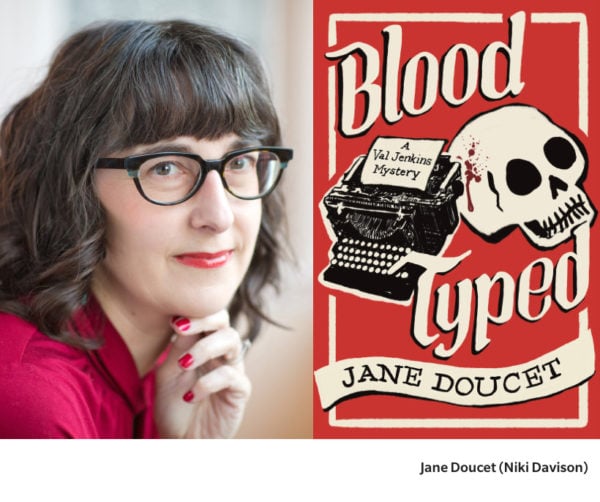
Excerpted from: Blood Typed: A Val Jenkins Mystery by Jane Doucet. Copyright 2026 © Jane Doucet. Published by Nimbus Publishing. Reproduced by arrangement with the publisher. All rights reserved.
Blood Typed is now available.
Jane Doucet is a Halifax-based Canadian journalist and author. She is the author of three previous works of fiction. Blood Typed is her first mystery novel.




 Contact us via email