Orange Shirt Day Hangover:
Municipalities, Indigenous Historians, and the Long History of Denialism
Indigenous historians’ community-based and public education work of researching and analyzing the past and presenting it in ways that make sense in the present has always been tricky. For too long, and even now, a decade after the release of the Truth and Reconciliation Commission (TRC) of Canada’s Final Report, most Canadians have little to no knowledge of Indigenous history, even if, after the release of the report, some Canadians did realize how little they had learned about Indigenous—and Canadian—history. For many citizens, the National Day for Truth and Reconciliation (NDTR), a Canadian observance that was first established in 2013 as Orange Shirt Day, became especially meaningful in the years following the announcement that 215 suspected “anomalies” were located on the grounds of the former Kamloops Indian Residential School in May 2021. Similar findings have since been made at the sites of other residential schools.1 Others however, often more vocal, still insist on the “history” they think they know, a history that hangs on thinly veiled stereotypes and shallow misconceptions drawn from general culture and spoken loudly in an effort to drown out carefully researched histories and the voices of Indian Residential School Survivors.2
As historians, we can offer various points of entry into the topic of Indian Residential Schools: I focus on health and labour; others, on sport and extracurricular activities, gender, militarism, land and land loss, commemoration, school staffing, architecture, religion and missionization, art and literature, biography, specific schools and regions, and so on.3 On Orange Shirt Day, however, our work can become generalized and contorted by and for audiences who expect certain types of information delivered in a certain way and to a certain end. There is often an appetite in these places for personal stories of individual pain and suffering.4 Theorized best by scholar Audra Simpson, our arguments about real anger, real frustration, and real need to identify and reject colonialism in all its forms can be pre-emptively framed in an affective performance of sorrow, contrition, and moving on.5 We must also contend with unsubstantiated arguments on practically any subject of Indigenous history that gains media attention.6 In this context, Indigenous historians can struggle to be heard.
When reconciliation events are held in places where Indigenous people are extremely under-represented, they can be especially fraught. For more than twenty years now, I have lived in Winnipeg, amid a much larger Indigenous population than in most cities. But I grew up in the heart of Simcoe County, near Barrie, Ontario, in what was then a predominantly white settler population. In places like Winnipeg, Indigenous people and Indigenous community laws and structures are part of everyday life and part of the bigger conversations about how things should work.7 For Indigenous historians, this means that at the very least, there is a lot more support to draw on.
Indian Residential Schools have local histories of their own. So far, Canadians have attended almost exclusively to the national history of Indian Residential Schools that the Truth and Reconciliation Commission documented, and that has driven public education efforts over the past decade. This comes at the cost of deeper and more localized understandings of Indian Residential Schools, allowing Canadians today to distance themselves from the schools’ day-to-day operations and legacies. Indian Residential Schools operated within and were enmeshed with local geographies and economies; they employed local citizens, and they fed low-skilled farm and domestic labour directly into the homes and communities that surrounded them.8
For the most part, citizens of these communities saw First Nations as a federal responsibility, a view that functioned as both mechanism and justification for racial segregation. While Canada’s Constitution does indeed give jurisdiction over “Indians” to the federal government, it does not deny provinces, municipalities, or individuals the ability to pursue meaningful relationships with Indigenous people and communities. And it certainly never restricted municipalities from directly reaping the benefits of land dispossession. David Parent’s examination of municipal tax rolls to understand Métis land dispossession in Manitoba reveals just how deeply implicated non-federal governing bodies are in Indigenous histories.9 Local histories of Indian Residential Schools can help citizens make sense of the past and the present, especially those from communities that were established on the borders of reserves they have come to know very little about.10 Until more of these closer connections can be developed, events organized to mark Orange Shirt Day require significant care and attention, alongside Indigenous history training and education programming, all sewn into municipal governing structures.
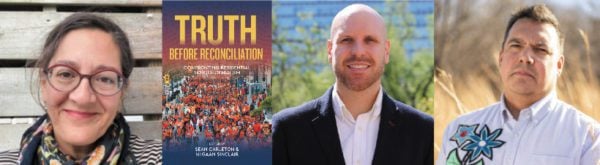
l. to r.: Mary Jane Logan McCallum, Sean Carleton, Niigaan Sinclair
Mary Jane Logan McCallum is the William Lyon Mackenzie King Visiting Professor at the Weatherhead Centre for International Affairs, Harvard University, and a Canada Research Chair in Indigenous People, History and Archives at the University of Winnipeg.
Sean Carleton is a settler historian and associate professor in the departments of History and Indigenous Studies at the University of Manitoba. His award-winning research examines the history and political economy of schooling and settler capitalism in Canada.
Niigaanwewidam James Sinclair is Anishinaabe (St. Peter’s/Little Peguis) and a professor at the University of Manitoba where he holds the Faculty of Arts Professorship in Indigenous Knowledge and Aesthetics in the Department of Indigenous Studies. Sinclair is also an award-winning writer, editor, and activist who was named to the “Power List” in 2022 by Maclean’s magazine as one of the most influential individuals in Canada.
Excerpted from: “Orange Shirt Day Hangover: Municipalities, Indigenous Historians, and the Long History of Denialism” by Mary Jane Logan McCallum in Truth Before Reconciliation: Confronting Residential School Denialism, Sean Carleton and Niigaan Sinclair, eds. Copyright 2026 © Mary Jane Logan McCallum; copyright 2026 © Sean Carleton and Niigaan Sinclair. Published by University of Manitoba Press. Reproduced by arrangement with the publisher. All rights reserved.
Truth Before Reconciliation: Confronting Residential School Denialism published on Sept. 9.




 Contact us via email