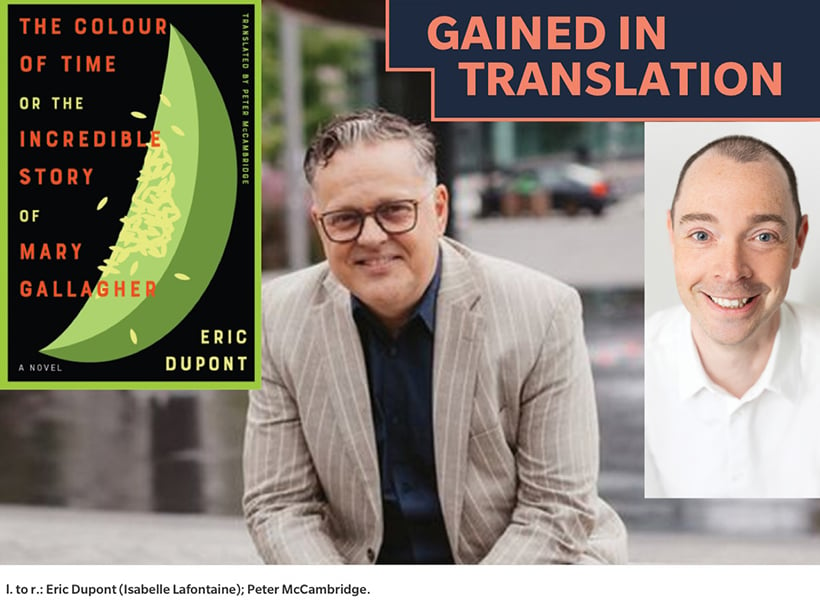
 The Colour of Time, or the Incredible Story of Mary Gallagher
By Éric Dupont, translated by Peter McCambridge
Véhicule Press, out now
By virtue of its location in Montreal, Véhicule Press enjoys close working relationships with the city’s French-language publishers, which often include reciprocal rights acquisition. In the case of The Colour of Time, or the Incredible Story of Mary Gallagher, it was Éric Dupont’s French-language publisher, Mélanie Vincelette of Éditions Marchand de feuilles, who first approached Véhicule about acquiring the book’s Canadian English rights, publisher Simon Dardick says. Véhicule’s new fiction editor Curtis John McRae read and loved the book, first published in September 2024 as La Ricaneuse, and it became his first acquisition for the press.
“It’s a rollicking tale that also celebrates Montreal – the City is essentially a character in the story – which we found very appealing,” Dardick says.
The book recounts the life of Mary Gallagher, an Irish-Canadian woman whose decapitated body was found in a house in the Montreal neighbourhood of Griffintown in 1879. Her ghost is reportedly sighted every six years in Montreal, three days after the Saint-Jean-Baptiste holiday. The novel moves through the city in time, from Gallagher’s 19th-century neighbourhood to Expo 67.
Pairing a French work with the right translator is essential, Dardick says, and Véhicule chose Peter McCambridge to translate The Colour of Time because of his “sublime” translation of Dupont’s 2018 Songs for the Cold of Heart (published by another Montreal press, Baraka Books). Dupont’s work has had previous success in translation: Songs for the Cold of Heart was shortlisted for the Giller Prize and a finalist for the Governor General’s Literary Award for translation in 2018. McCambridge won the 2023 Governor General’s Literary Award for translation for Rosa’s Very Own Personal Revolution, his translation of Dupont’s La Logeuse.
“We are extraordinarily fortunate to be in a position to present the best of Quebec’s French-language literature to the English-reading world,” Dardick says. “Frankly, we enjoy discussing the possibilities with our francophone colleagues, and when an acquisition has been made, exploring the rich vein of literary translators we have in Canada.”
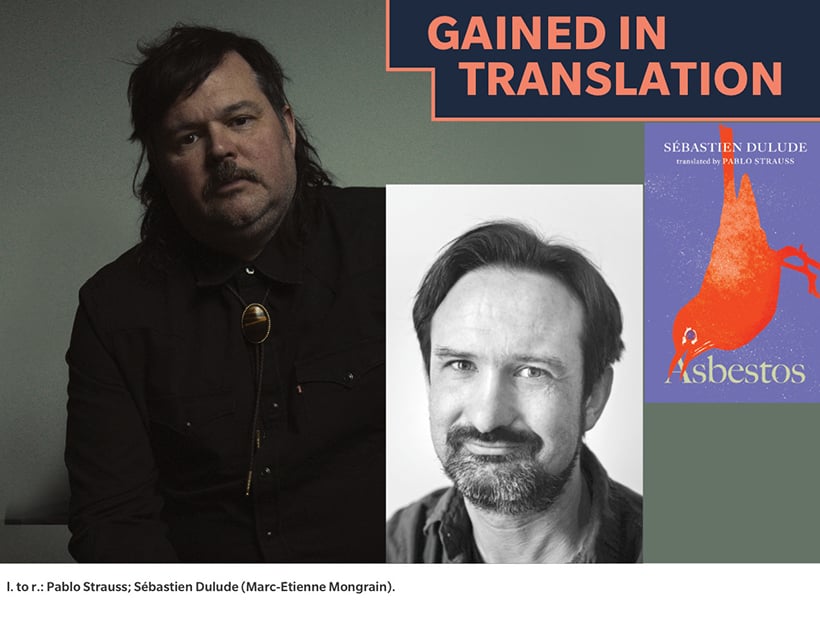 Asbestos
By Sébastien Dulude, translated by Pablo Strauss
Coach House Books, Oct. 6
Translator Pablo Strauss first brought Sébastien Dulude’s novel Asbestos to the attention of Coach House Books editorial director Alana Wilcox. Strauss regularly works with the Toronto-based press and will either bring French books to Wilcox or read French books at the press’s request. After identifying the book as a perfect fit for Coach House, he prepared a report about the book and provided Wilcox with a sample translation.
The novel, a coming-of-age story set in an asbestos-mining town in the late 1980s, won multiple awards in Quebec, where it was published as Amiante by French publisher Les éditions J’ai lu in 2024. It is Sébastien Dulude’s debut novel, though Wilcox knew him as publisher of La Meche (an imprint of Groupe d’édition La courte échelle) before he turned to writing.
“We’re in a moment where mining as an industry is on the wane, and it’s fascinating to think about what that does to the people who live in a place where that’s the job,” Wilcox says. Beyond the novel’s subject matter, its style and use of language is what confirmed Strauss’s identification of it as a fit for Coach House’s list.
“[Dulude] manages to play between different registers, the mining town kind of dialogue but also very sophisticated literary prose,” Wilcox says. “That’s a tough thing to manage and he did a great job of it.”
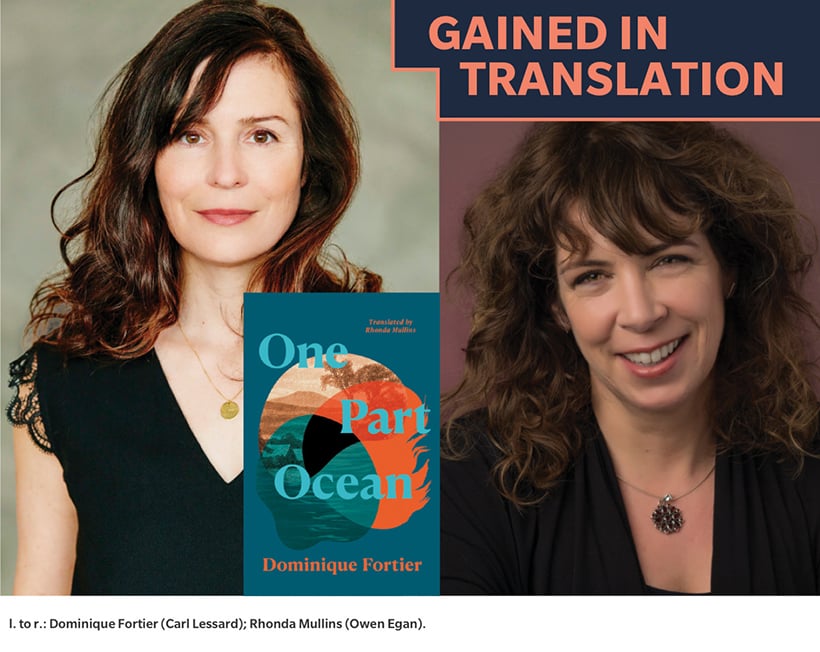 One Part Ocean
By Dominique Fortier, translated by Rhonda Mullins
Coach House Books, Oct. 6
One Part Ocean is the fourth English translation of Dominique Fortier’s work to be published by Coach House Books, so the decision to include this title on their list “was kind of a given,” Wilcox says.
The introduction in 2011 of the Canada Council for the Arts’s Translation Rights Fair, a one-day event that Wilcox likens to a kind of speed dating for publishers, has given Coach House the opportunity to discover which French-language publishers they work well with.
“We’ve developed really great longstanding friendships and know each other’s lists,” Wilcox says. “We still go to the translation fair, but we have a relationship outside of that.”
Fortier’s Pale Shadows, which was published in 2024 and also translated by Rhonda Mullins, was shortlisted for the 2025 Carol Shields Prize for Fiction and nominated for the 2025 Dublin Literary Prize. One Part Ocean reimagines the friendship between American authors Herman Melville and Nathaniel Hawthorne after the two met while Melville was writing Moby Dick. La part de l’océan, published by Quebec City–based Alto in 2024, was shortlisted for the Académie des lettres du Québec’s 2025 Ringuet Prize and longlisted for the 2026 Quebec Booksellers’ Award.
Wilcox says it’s heartening to see increased interest in translated books, particularly at a time when the work of translation is so often outsourced to AI.
“Especially at a moment where the translators’ livelihoods are threatened by AI, it feels like an important moment to assert how important real human translation is,” Wilcox says. “It feels like it’s more important than ever to assert that that’s an important part of Canadian literature, that conversation between [French and English literature].”
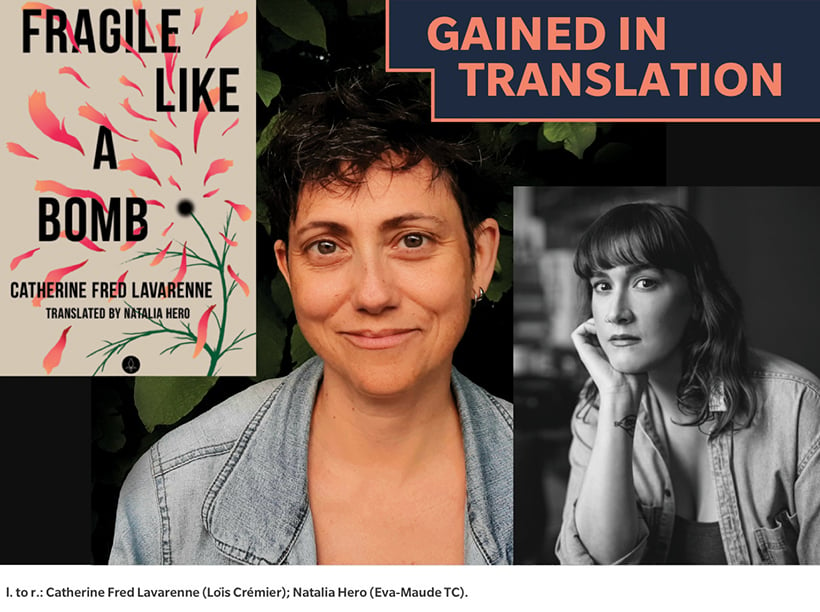
Fragile Like a Bomb
by Catherine Fred Lavarenne; translated by Natalia Hero
QC Fiction/Baraka Books, Oct. 1
Catherine Fred Lavarenne’s Fragile Like a Bomb intertwines culture and politics as the sexual violence against women in society is brought to the fore with #MeToo denunciations in Quebec’s literary world. The novel follows a Montreal writer-turned-left-wing-politician who, despite her political inexperience, becomes the Quebec Minister of Culture and finds her own experiences reflected in those of the women who have come forward.
Lavarenne’s sophomore novel (first published by VLB éditeur in 2022) fits neatly into Montreal English-language publisher Baraka Books’s QC Fiction imprint, which publishes one to three translations annually. This year, the list also includes It’s All Coming Back to Me Now, Jean-Michel Fortier’s coming-of-age novel, translated by Jonathan Kaplansky, also publishing in October.
Founded in 2016 by Peter McCambridge, the imprint’s initial focus, which has varied over the years, was to publish “young authors and to have young translators translate them,” says Robin Philpot, Baraka Books’s publisher and president. At the time, “we had noticed and heard that because translations into English in Canada were done by a small group of very good translators, the English books often read the same even if the original French had completely different styles,“ says Philpot. “We wanted to change that.”
Baraka Books is also known for its political nonfiction, so the novel’s themes also mesh with the rest of the publishing program. Mélissa Bull, the former editor of QC Fiction, “saw the book as an excellent example of the #MeToo phenomenon in the literary world,” says Philpot, “but also [of] the intersection of that world with politics and government.”
The publishing house is also always on the lookout for nonfiction to translate, including this fall’s At Any Cost: Trudeau, Québec and His Will to Dominate by Guy Bouthillier, translated by David Hagen.
“Sometimes, translators pitch books, but generally we choose the ones we want to publish,” says Philpot. The Baraka team “[follows] the French-language publishers closely. We know about books often before they come out in French and have very good relations with French-language publishers. Some also publish French translations of our books.”
This article contains affiliate links. Quill & Quire has partnered with Booksellers.ca, a network of more than 180 independent bookstores across Canada, so we may earn a small commission when you purchase through links on our site — at no additional cost to you. More about Booksellers.ca.




 Contact us via email