It all started with the idea to launch a new magazine called OWL.
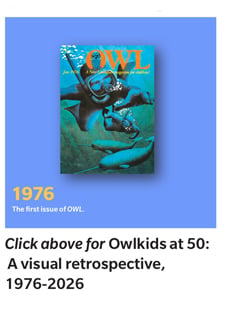
Michael de Pencier, the co-founder of Key Publishers, formed the Young Naturalist Foundation, a not-for-profit and charity, in order to take over the Young Naturalist magazine that had been published by the Federation of Ontario Naturalists since the 1950s, and create a new one called OWL. The motivation was to offer all Canadian children a magazine that encapsulated the foundation’s love for the environment and for science. OWL – an acronym for outdoors and wildlife – was launched by the foundation’s Annabel Slaight and Mary-Anne Brinkmann in January 1976.
The inaugural issue included an article by Farley Mowat about his Newfoundland dog entitled “My Dog,” and the Mighty Mites, a black-and-white comic about kids who shrink to explore the natural world, created by Emily Hearn and Mark Thurman.
OWL was such a hit out of the gate the founders started to publish a handful of books under the Owl Books name, based on the content and the characters from the magazine, such as OWL’s Amazing But True, as well as launching another magazine for younger readers, Chickadee, in 1979.
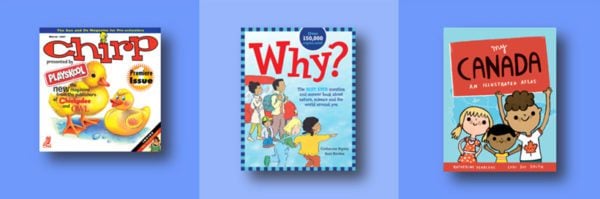
 Unlike OWL, which is for ages 9–13 and speaks to kids invested in the world around them, Chickadee is intended for ages 6–9 and is more humorous in tone. And Chirp, the final magazine in the trio launched in 1997, which is read to children by their parents and is smaller and square to better fit in small hands, is geared to children between the ages of 3 and 6. It won Best Magazine at the National Magazine Awards in its first year.
Owlkids expanded its reach in 1985 with the release of OWL/TV. The series followed the configuration of the magazine, with wildlife features, handy tips, and the HOOT Club, a segment that acknowledged the environmental stewardship of young people. OWL/TV was launched with PBS as the initiating broadcaster, and CBC came aboard later as the Canadian broadcaster. The show aired for 10 years.
The magazines and book publisher operated independently for a number of years though content for books was still being pulled directly from the magazines, namely the bestselling Why? and How?, which are based on questions that were sent in to the magazine from children. Owlkids was acquired by Bayard Canada in 1997, and in the early 2000s, Owl Books was renamed Maple Tree Press and was releasing titles as a separate entity. The magazine and book divisions were united in 2008, when Owlkids’ parent company, Bayard Canada, purchased Maple Tree Press, acquiring the backlist and rebranding it as Owlkids Books.
The two divisions still work together today. “There are definitely still connections,” says Karen Boersma, publisher of Owlkids Books. “Nonfiction will always be part of our DNA, but in 2010, we began to add picture books that were great stories for kids.”
Just before Boersma joined Owlkids Books in 2012, the company decided the next big milestone was to enter the U.S. market. The push required a lot of energy from all involved, but proved successful because the move has increased sales three to four times over. Their books are distributed in the U.S. by Publishers Group West.
“Our mantra is always don’t publish more books, sell more copies of the books we publish,” Boersma says. “I love that, and I’d say that has also always been a focus of ours. From an editorial point of view, we are absolutely creator driven. We want to ensure we are working collaboratively to help authors and illustrators bring their vision to life. But we also think it’s a huge part of our responsibility to do a great job marketing and selling their books, because that’s how we all achieve success.”
International rights sales have also been immensely lucrative for Owlkids Books. The avenue picked up speed after Boersma and Judy Brunsek, director of sales and marketing, came on full time. Since 2012, they’ve increased their licensing sales tenfold. The exposure has also resulted in Owlkids Books receiving a nomination for the Bologna Prize for the Best Children’s Publishers of the Year three times, most recently in 2022.
“It’s really nice to be nominated, to be recognized by your peers,” Boersma says. “That was a big milestone for us.”
A priority for Owlkids Books is publishing voices not traditionally represented in the industry. Willie Poll, a member of the Métis Nation of Ontario and acclaimed children’s author who started working with the publisher in 2023 with her book A Salmon Story, was brought on as an editorial consultant in January 2025.
“She’s delightful in every way,” Boersma says. “She helps us discover new voices from Indigenous communities across Canada. We wanted to publish more books by Indigenous authors, but we wanted to do so by working directly with communities.”
The same is true for the magazines, which over the last 10 years have featured Indigenous writers and illustrators. “We did three issues where we partnered with CanoeKids and GoodMinds,” Angela Keenlyside, publisher of Owlkids Magazines, recalls. “Working with three Indigenous communities – Haida, Mi’kmaq, and Ojibwe – that centred on content coming from the communities, which was really great.”
The magazines are seen as a training ground for the books division. New illustrators just out of school who contribute to the magazine are shown to the editors on the books side.
“We love that, and I would say on every list there’s at least a couple of either first- time authors or first-time illustrators,” Boersma says. “It’s something that’s also part of our mandate, and it’s fun.”
When Boersma and Keenlyside think about the next 50 years, the word that comes to mind is growth.
“We’re not looking to reinvent our businesses,” Boersma says. “I want to sell more copies of our books absolutely everywhere, because I think our authors and illustrators are insanely talented, and I would like to bring their stories to as many people as possible. So, for us, it’s always about growth, but I don’t see us changing our mandate or what we’re passionate about in terms of bringing great stories and great content to kids.”
“I think, especially now, kids having access to fact-checked, vetted, real information that’s not AI-written is important. We are real people creating real content that’s meaningful for kids,” Keenlyside echoes. “That helps kids grow into good humans. And as part of the 50th, the birthday issue of OWL will feature different people in different careers that recall their favourite memories from reading the magazine. One such person is Andreas Dutz, an animator at Pixar, who remembers doing the crosswords and puzzles. It’s very meaningful, and we want to make sure, whether it’s in print or in digital, that we remain there for our audience.”
This doesn’t mean the magazines won’t explore new ways of disseminating content, they do that all the time. But it does mean making sure that kids see themselves will always come first.
“I was looking at reviews for You Are Stardust [about how we are intimately connected to the natural world], and one of the things they all commented on was that it was hopeful,” Boersma says. “And I think even if we’re talking about difficult subjects, and we’re not going to shy away from those, especially on the books side, it helps kids make sense of the world around them, an increasingly complex world.”
“When we go to Word on the Street, it’s very motivating, because every year there is a group of 20-year-olds that walk by and suddenly go, ‘Oh my God, I used to read this,’” Keenlyside recounts. “The impact is real, and it’s very heartwarming to see that it’s not just four-year-olds coming up. It’s people who read it, and have a memory of a Canadian product.”




 Contact us via email