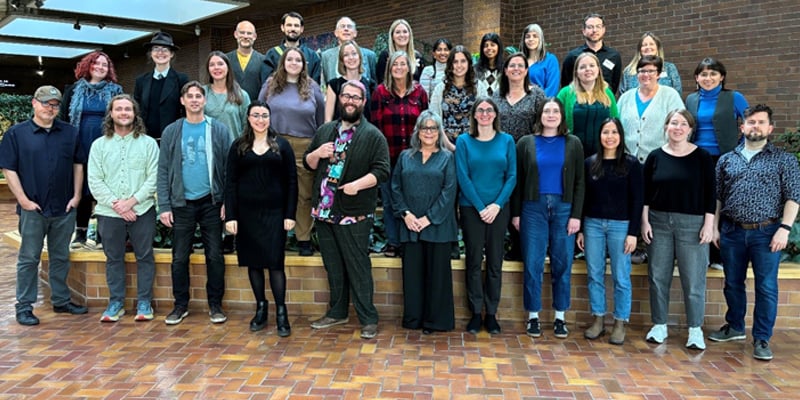
The staff of Broadview Press in 2024. (Photo courtesy Broadview Press)
When Don LePan started Broadview Press in 1985, he thought the independent academic publisher could go one of two ways: it would either be an instant success, with professors immediately recognizing the unfulfilled need it addressed in the market, or, given the numbers on success rates of new, small businesses, it would be a flop and fold within its first few years.
A third, less extreme option – that it would be “a tough slog,” struggling to make a profit for the first 10 to 12 years of operation – didn’t occur to him at first.
“It was that third possibility, of course, that turned out to be how things happened,” LePan says.
LePan, who started working at university presses straight out of university, traces the motivation to start Broadview Press to an experience he had while working at Oxford University Press in the early 1980s. A pair of professors at the University of Alberta were interested in publishing an anthology of early children’s literature, and Michael Harrison, a friend who LePan had hired at OUP, brought it back to the press, where both of them were interested in publishing the title. Under the multinational structure of the press, however, proposals were to be sent to the branch with the biggest prospective market for a title.
“If we’d been playing by the rules we would have passed that on to OUP New York, and said, here’s an interesting proposal from two people in Alberta, and maybe you’d like to publish it,” LePan recalls, noting the U.S. had the largest market for early children’s literature courses. Instead, they embellished the Canadian market for such titles and managed to publish the book – From Instruction to Delight: An Anthology of Children’s Literature to 1850 – from the Canadian OUP office.
“That experience left behind a feeling in Michael’s mind as well as in mine that there should be a place for a Canadian-owned and internationally oriented publisher like that in the humanities and social sciences,” LePan says.
He left the press not long after, and taught English at a rural school in Zimbabwe from 1982 to 1985. It was from there that he started the work that would become Broadview Press, sending mimeograph copies of a prospectus for a publishing company to potential investors and authors in 1985.
Enough investors came on board to make the operation viable, and when LePan and his wife moved back to Canada, they rented a house in Peterborough with a garage that would serve as the warehouse for the first two titles: Readings in Social Psychology: Classic and Canadian Contributions, edited by Brian Earn and Shelagh Towson, and Canadian Financial Markets, by W. T. Hunter.
Since those first inauspicious days in the “ramshackle little house,” when the employees numbered one, Broadview has grown. Harrison would join LePan at Broadview in 1992 for 16 years, and serve as president of the company before moving to UTP. The press, which marks its 40th anniversary this year, has published more than 1,000 titles, sees annual sales of $4 million, and now counts a staff of more than 30 at multiple offices, from the West Coast, where LePan, who is CEO of the company, works in Nanaimo, B.C., to the East Coast, where two Broadview staffers are based in Wolfville, N.S. Broadview president Stephen Latta works out of the Calgary office, where editorial acquisitions are largely handled, and sales and marketing is largely led by the Guelph, Ontario, office. The firm’s largest office is in Peterborough, where the warehouse is located.
Forty years in independent academic publishing is no small feat, and Broadview has adapted to changing market and economic conditions on several occasions. In 2000, when the number of shareholders hit the limit in Canada for a private company, LePan wanted to continue growing, so he took the company public; for 10 years it was a publicly traded company on the Toronto Stock Exchange. (It became a private company again in 2010, after the work for the required quarterly reports grew prohibitive (about $100,000 a year.) After a rising Canadian dollar in 2007 and 2008 put pressure on the company’s operations (given that nearly two-thirds of the company’s sales are to export markets, the high loonie had the opposite effect on sales revenue), Broadview sold its social science lists to the University of Toronto Press.
Its focus since then has been on the humanities. In the U.S. market, in English literature in particular, Broadview has become “a very substantial presence,” and despite the current trade concerns, LePan sees the U.S. market offering the press room for expansion.
Looking ahead to the future, LePan sees “reasons for optimism.” Although the size of the university markets isn’t growing, the possibilities available to Broadview within it have grown in recent years, as large multinational educational publishers appear to be less interested in publishing new editions of previous titles.
A two-volume anthology of Canadian literature, for example, edited by Laura Moss at UBC and Cynthia Sugars at the University of Ottawa, was first published by Pearson in 2009. Moss and Sugars were interested in publishing an updated edition of the title, but Pearson wasn’t. The pair negotiated an exit from their contract and came to Broadview, which published Canadian Literatures in English: Texts and Contexts, Volume 1 – Second Edition in August. The second volume will be published in May 2026.
And the multiple-volume and multiple-edition Broadview Anthology of British Literature has become the second-bestselling anthology in the market, behind the number-one Norton.
“It’s not a growing market; it continues to decline at least a little bit almost every year, but it remains large,” LePan says.
LePan would like to see Broadview continue to grow, albeit more modestly than in its early years, when it was growing 23 per cent year over year, as well as expand its presence in the social sciences again.
“I always tend to be an optimist,” says LePan. “There are certainly lots of clouds on the horizon – it seems like every week there’s a new article in some major publication about the death of the liberal arts, and the social sciences and universities, and so on, and there are just threats to universities in particular in the sorts of areas we publish in the humanities and social sciences. But there are a few things that make me hopeful for Broadview.”




 Contact us via email