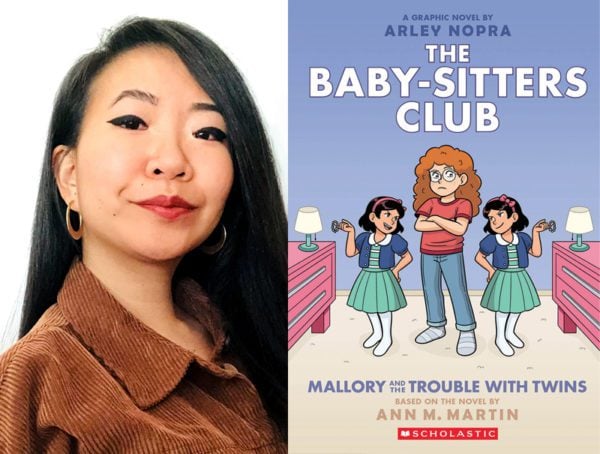
Arley Nopra, who previously worked on The Dragon Prince series, now calls the world of The Baby-Sitters Club home. The popular series, originated by Ann M. Martin, relaunched in 2006 in a graphic novel format. Nopra’s second foray in the series (the first was published by Scholastic’s Graphix imprint in 2023), Mallory and the Trouble with Twins, follows Mallory as she struggles with a difficult babysitting assignment. So far, the graphic novel adaptation has been on the Bookmanager indie bestseller kids fiction list for 25 weeks.
Nopra spoke with Q&Q about what it feels like to be part of a beloved series, and why she believes readers are connecting with Mallory and the Trouble with Twins.
How did you come to be involved with the series?
I was working on the Dragon Prince graphic novel series as a colourist, which is also published by Scholastic. Cassandra Pelham Fulton, who is an editor on The Baby-Sitters Club (BSC) team noticed my work and she reached out to my literary agent to ask if I would be interested in auditioning for the BSC adaptation. I looked into it, and was willing to give it a shot.
They asked me to draw most of the main cast of The Baby-Sitters Club. Based on a few pages from one of the original novels, I also had to draw three pages so the BSC team could determine if I was the right fit. They ended up really liking what I did – including Ann M. Martin. I was fortunate enough to get a role as an adapter for the series, and I’ve been doing it now for the last four years.
What does it feel like to be part of such a beloved series?
Gosh, it’s really been so amazing. It’s such an honour to be a part of a series that has been around since the ’80s and has such a rich history. I can’t believe that I’m working on this series sometimes; I feel very fortunate. I’ll talk to readers at events, and learning how much of an impact these stories have had on them is such an honour.
Did you read the original series growing up?
I didn’t read them growing up. I was familiar with The Baby-Sitters Club, and I saw the books on library and bookstore shelves. I even remember seeing them at Scholastic Book Fairs, but, for some reason, I just never ended up getting into the series. It wasn’t until I became an adapter that I began to read them. And I really love them now. I wish I had read them when I was a kid, because I would have been such a big fan of all the characters, especially Claudia – I relate a lot to her stories.
Do you think coming to the series as an adult actually helped you with the process?
In some ways, yes, because I’m not tied to the past, if that makes sense. I’m not so tied down to who the characters were in the ’80s and ’90s, so I look at everything with a fresh mindset. Everything feels new to me.
Mallory and the Trouble with Twins is your second book in the series. Is there anything you learned from Claudia and the Bad Joke that you brought to this book?
Claudia was my first attempt at adapting a book so I learned a lot. What I took away from Claudia and the Bad Joke was the creative process. I learned how to go from step one all the way to the end. I had a much better handle on it for the second book.
When we work on the BSC series, we have to go through a certain number of stages. Usually it starts with reading the original novel. With Claudia, I learned how to read the original, but also how to take what’s important from the novel and do a little bit of problem solving. When you’re adapting a novel to a graphic format, or when you’re adapting anything, there will always be changes necessary.
To date, Mallory and the Trouble with Twins has been on the bestsellers list for 25 weeks. What does that feel like?
I didn’t know it’s been that long. That’s amazing! Being part of the series, and then having it on the bestsellers list is really cool. I have no words.
Why do you think readers connect so deeply with Mallory and the Trouble with Twins?
I think it’s because Mallory is a story about self-expression and individuality. It’s what a lot of kids are going through, especially in the age range [middle grade] reading the The Baby-Sitters Club. This is around the time when kids really want to discover what they like and what they dislike, and be their own person. Carolyn and Marilyn struggle with being mistaken for each other because they look exactly alike, are dressed exactly alike. It’s when they learn to talk to their mom that they’re able to pick what they want to wear and express themselves. The same is true for Mallory: she wants to get her ears pierced, and she wants to get a haircut, but her parents are pretty strict about it. Once she learns to communicate her feelings to her parents, they hear her, and she is allowed to do those things. I believe that’s what resonates with kids. It even resonated with me as I read the book.
Can you speak about what you’re working on now?
I just wrapped up Dawn on the Coast. It’ll be released in spring of next year. In this one, Dawn gets to travel to California, so she’s going to be away from the Baby-Sitters Club. It was exciting to work on, because I was able to create scenes outside of Connecticut, which is where the series lives. Dawn on the Coast is more dramatic than the other titles. Her parents are divorced, and she’s going to visit her dad. She has this internal struggle of whether she should stay in California or return to Connecticut. I’m also working on Mary Ann and the Search for Tigger, which is coming out in, I believe, 2027.
This interview has been edited and condensed.




 Contact us via email