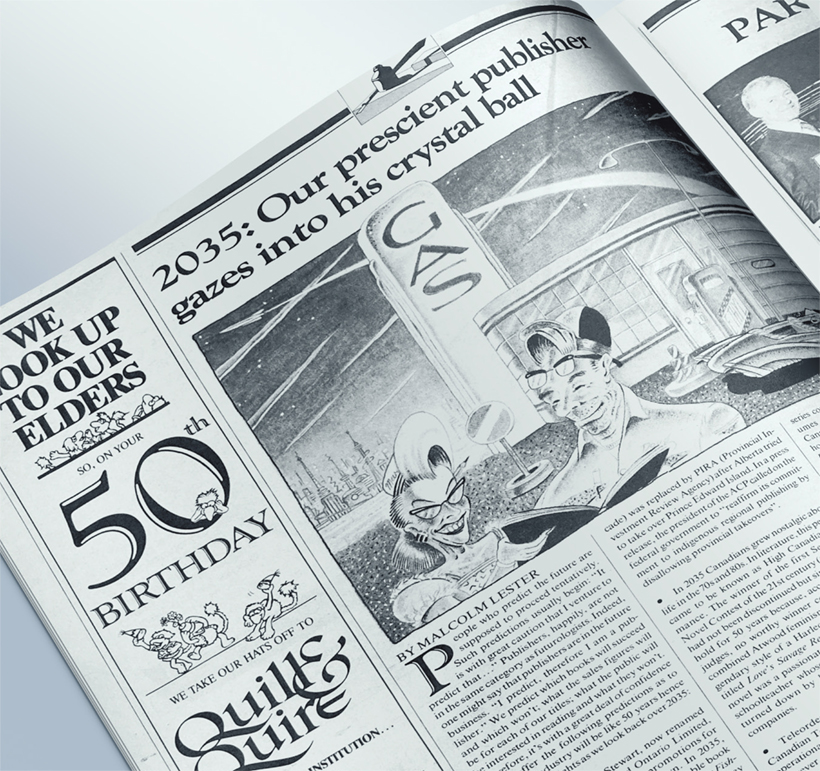
Detail from Q&Q’s April 1985 issue.
When marking the 50th anniversary of Quill & Quire in April, 1985, the late publisher Malcolm Lester had some fun predicting what the future of the Canadian publishing industry might look like at the time of the magazine’s 100th anniversary. He offered a satirical vision of 2035 that very much reflected the era (Telebook? A Day in the Life?), but some of the pokes at the industry are evergreen. Though this year marks only Q&Q’s 90th anniversary, we are much closer to 2035 than to 1985, so in the spirit of resurrecting an odd time capsule we revisit his whimsical projections for the Canadian book industry.
2035: Our prescient publisher gazes into his crystal ball
By Malcolm Lester
People who predict the future are supposed to proceed tentatively. Such predictions usually begin: “It is with great caution that I venture to predict that…” Publishers, happily, are not in the same category as futurologists. Indeed, one might say that publishers are in the future business. “I predict, therefore I am a publisher.” We predict which books will succeed and which won’t; what the sales figures will be for each of our titles; what the public will be interested in reading and what they won’t.
Therefore, it’s with a great deal of confidence that I offer the following predictions as to what our industry will be like 50 years hence – some highlights as we look back over 2035:
• McClelland and Stewart, now renamed McClelland, Stewart and Ontario Limited, continued the flamboyant promotions for which it is now so well known. In 2035, MS&O published a lavish coffee-table book entitled The Complete Guide to Inuit Ice Fishing. To launch the book, MS&O flew 50 key media personalities to Tuktoyaktuk in the Northwest Territories. Disaster almost occurred when, during a hands-on demonstration of the Inuit technique, the entire party became stranded on an ice floe headed for the Arctic Ocean.
• The Department of Communications continued its active support of the Canadian publishing industry. Around the turn of the century the Department was made a Crown corporation called Culture Canada or Cult-Can, as it came to be called. This new acronym caused confusion among ordinary Canadians who thought it referred to a resort on the Gulf coast of Mexico. In 2035 CultCan again reaffirmed its support for Canadian publishers by renewing for the 29th time the DOC Book Publishing Development Program, pending, of course, a full evaluation of the entire Canadian book-publishing industry.
• Canadian publishing companies continued to be concerned about the ownership of the industry. However, in 2035 FIRA (the name Investment Canada lasted about a decade) was replaced by PIRA (Provincial Investment Review Agency) after Alberta tried to take over Prince Edward Island. In a press release, the president of the ACP called on the federal government to “reaffirm its commitment to indigenous regional publishing by disallowing provincial takeovers”.
• In 2035 Canadians grew nostalgic about life in the 70s and 80s. In literature, this period came to be known as High Canadian Romance. The winner of the first Seal First Novel Contest of the 21st century (the award had not been discontinued but simply put on hold for 50 years because, according to the judges, no worthy winner could be found) combined Atwood feminism with the now legendary style of a Harlequin romance. Entitled Love’s Savage Rejection, the winning novel was a passionate tale of a Lethbridge schoolteacher whose manuscript had been turned down by 14 Canadian publishing companies.
• Teleordering, under the aegis of the Canadian Telebook Agency, finally became operational in 2035. Critics of teleordering, however, pointed out that the current technology of nanosecond laser transmission tended to make obsolete a procedure based on turning a microfiche recorder by hand and wondered, therefore, why more than $24-billion had already been spent prior to implementation.
• Canadian publishers remained active in the international rights field in 2035. The first Canadian trade mission to Mars was mounted in that year. However, controversy broke out over whether Mars was an open-market territory or part of the U.S. The Canadian government, in a rare showing of solidarity with Canadian publishers, took the position that Mars was indeed an open-market territory because, although the American flag flew over Mars, Canadians could take great pride in the fact that a Canadian firm had manufactured the flag-pole.
• The last volume in the Day in the Life series was published in 2035. After the initial publication of A Day in the Life of Canada, the series continued well into the 90s with volumes on various regions and cities of Canada. The series came to an abrupt halt, however, with the publication of A Day in the Life of Baie Comeau and the attendant charges in the House of Commons that the book was a patent attempt to revive the flagging fortunes of the ruling party.
The series began anew in the early 2000s when the publisher realized that the corporate sponsorship idea — so successful in launching the series — could be given a new twist. Thus, A Day in the Life of the Argus Corporation was published with much ballyhoo, with the entire print run of 150,000 copies being purchased by the corporation. This led the president of the publishing company to wax rhapsodic about the fiscal responsibility of branch plants compared with those Canadian-owned companies that were always getting government hand-outs.
In 2035 A Day in the Life of Petro Canada was published to little fanfare and even less success. Certain prescient reviewers pointed out that since all that was left of this once mighty Crown corporation (after decades of dismantling) was an all-night gas station and convenience store between Kelowna and Penticton, a certain amount of public indifference could be expected. However, a corporate sale of sorts was achieved when Doug and Mary Flynn, the proprietors of the service station, bought three copies to give away as Christmas presents. The remaining 249,997 copies were pulped, giving The New York Times its best net price ever on Canadian newsprint.
• Heavy returns continued to plague publishers in 2035. To remedy this situation, the Canada Council (now a division of CultCan) decided to subsidize returns rather than deficits. This was done on a 1:1 matching basis, with the Council providing one dollar for every dollar in returns. Critics of the program pointed out that publishers now had no risk. However, supporters of the Council’s position defended the policy on marketing grounds, arguing that, well, you had to get the books into the stores in the first place.
All in all, it was a pretty good year.




 Contact us via email