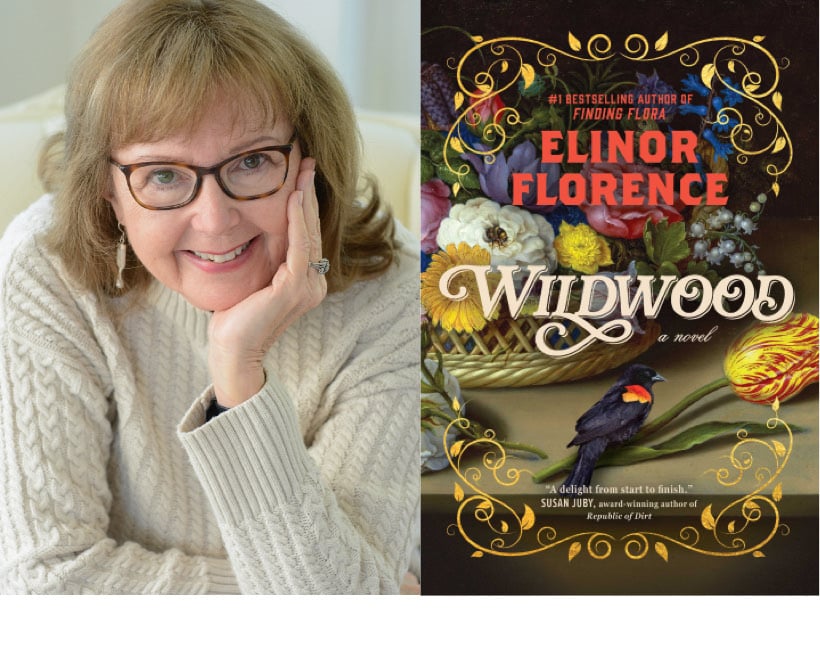
 Elinor Florence isn’t exactly new to the bestseller lists – her first novel, Bird’s Eye View, set during the Second World War, published by Dundurn Press in 2014, was a bestseller.
But when Finding Flora, her third novel set in the early 1900s in Alberta, was published by Simon & Schuster last April, it was chosen as an Indigo Heather’s Pick and debuted at number-one, taking her success to previously unreached heights. The novel follows Flora Craigie, a young Scottish immigrant who leaps off a moving train in the book’s opening pages to escape the abusive husband who brought her to Canada. She pursues homesteading, teaching herself how to work the land and survive winter, in rural Alberta while hoping to avoid detection by her erstwhile spouse.
The novelist, who first turned to fiction after retiring from a successful career in journalism, has maintained a robust website and monthly newsletter for the last 12 years, regularly corresponding with readers and honouring book club requests when possible. But since Finding Flora was published, she has had to create an Excel spreadsheet to keep track of all of the requests for speaking engagements and book club visits. She has also had to turn down between 40 and 50 of these invitations over the last year because there simply wasn’t enough time to honour all of them.
“My local bookstore guy here, the owner of Four Points Books, asked me with all my success how my life had changed, and I said, ‘I answer a lot more emails,’” she says, laughing.
After publishing Bird’s Eye View and her second novel, Wildwood, a contemporary novel with a historical component that dates to the 1920s, in 2018 (also published by Dundurn), Florence worked on what would become her third book, Finding Flora. She was unable to reach a publication agreement with Dundurn Press, and parted ways with the Toronto-based publisher in August 2023. The next month, she submitted the manuscript to Simon & Schuster Canada, and received an offer to publish the book two weeks later.
As Finding Flora moved toward publication, Florence decided to buy back the rights to her first two books to see if she could find a way to get them to a wider audience. After the instant success of her third novel, she acquired an agent and negotiated a new, three-book deal with Simon & Schuster Canada in July 2025 for her first two novels and a new book, titled Grasslands, which is slated for publication in April 2027.
The reissue of Wildwood debuted in the number-three spot on Bookmanager’s Canadian Fiction list on May 4. It has remained on that list in the six weeks since, claiming the number-nine spot this week.
Bird’s Eye View will be reissued by Simon & Schuster in November, and Florence is optimistic that her readers will be “equally enthusiastic” about it.
She recently spoke to Q&Q from her home in Invermere, B.C., about her unexpected – and continued – second-career success.
Did you expect Finding Flora to do so well so immediately?
No, not at all. In fact I was doing a signing at a bookstore in Edmonton the first week it came out and I got an email from Adrienne Kerr, my editor at Simon & Schuster, and the subject line, in caps, was ARE YOU SITTING DOWN?
I read the email and I just leaped to my feet and shrieked in the middle of the bookstore because it was so exciting. I was running around showing my phone to everybody, because it had debuted at number one.
Did you expect Wildwood to do so well when it was reissued this year?
I thought it would do well; I knew that it ticks all the boxes in terms of contemporary fiction – it’s women’s fiction, it has a historical component, it’s true history, which people seem to really love. Also, I think there’s a trend towards getting away from technology and living a simpler lifestyle and that’s appealing to a lot of people.
How did you transition from journalism to fiction in the first place?
I was a journalist all my life and I retired from journalism in 2012. I always had it in the back of my mind to try tackling a novel about a Canadian woman in uniform. I started researching that novel while I was writing for Reader’s Digest: in between assignments, I would research aerial photography, which is what my heroine does in the book.
When I finished with journalism I finally thought, okay, I’ve got to try writing this novel. It was a difficult transition, I can tell you that. As a journalist, you’re trained all your life never to make anything up, and to go from never making anything up to making everything up, it’s a huge leap. I almost feel it would be easier if you came at it cold, instead of moving from journalism. I particularly had difficulty with dialogue: I was so used to transcribing the words that other people had spoken that to create words out of thin air was a challenge. However, I did it. And the first publisher I sent it to accepted it, so I really can’t complain. I didn’t undergo the agony of rejection like so many other authors.
What do you think it is about Flora, the protagonist of Finding Flora, and Molly, the protagonist of Wildwood – these almost bloodymindedly independent female main characters – that is so compelling for readers?
Well I think you nailed it. They didn’t come from great backgrounds but they somehow mustered the strength to rise above their own history and tackle life’s challenges. What I’m hearing from readers is that they’re getting a little weary of dark and disturbing material – people these days want to be uplifted, and they want to be inspired, and they want role models. And, spoiler alert, I only write happy endings, and I do think that people like a happy ending.
I also think the historical aspect is important for a lot of people. Bird’s Eye View was so meticulously researched; I was fortunate enough to write it when there were still living wartime veterans, and I interviewed dozens of veterans to get every authentic detail I could into my book. It’s the same with my other novels: I read and read and read. For my new book, which is set in ranching country, I’ve probably read about 40 books about ranching. Ask me anything about cows and horses!
Grasslands, your next book, will take readers to the world of ranching in the 1890s: can they expect a plucky female protagonist to guide them on the journey?
Oh you bet. It will have many of the same components as my other books.
This interview has been edited and condensed.




 Contact us via email