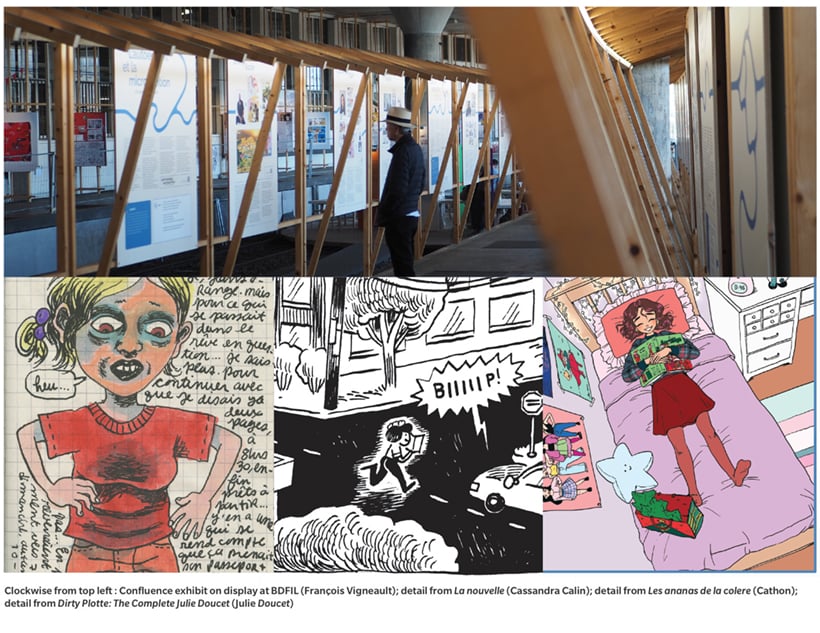
 For the third time this spring, an exhibit showcasing the vast and varied realm of Quebec comics will be on display for attendees of a comic arts festival.
“Confluence: The World(s) of Contemporary Comics from Quebec” will be featured at this weekend’s Toronto Comic Arts Festival (TCAF).
The exhibit debuted at the BDFIL festival in Lausanne, Switzerland, where it was on display in an old train station from April 29 to May 4 in one of the festival’s exhibit spaces. Montreal-based cartoonist François Vigneault (creator of the sci-fi graphic novel Titan, co-creator of the YA series 13e Avenue, and the marketing manager at Montreal’s Editions Pow Pow/Pow Pow Press) curated the exhibit over a number of months earlier this year. The project was born out of a partnership between Festival de bande dessinée, Lausanne (BDFIL) and the Montreal Comic Arts Festival (MCAF): Switzerland was the special guest of the MCAF in 2025, and this year, Quebec was featured as the special guest at BDFIL.
Vigneault, who was born in the U.S. but has lived in Quebec for 11 years, brought his unrestrained enthusiasm for the Quebec comics scene to the exhibit’s curation.
“I think that Montreal has the best comic book scene in the world,” Vigneault says. “I’ve lived in a lot of interesting places in the United States, and I’ve traveled around a lot, and I keep being struck by the fact that there’s so much amazing work coming out of all of Quebec.”
Initially, Vigneault selected 20 artists to include in the exhibit, but eventually expanded that number to 24 and says it was painful to have to exclude creators from his selections. The Confluence exhibit on display in Switzerland featured panels in French, with a scannable QR code that took viewers to the English version, as well as to a simplified French version aimed at children. The Montreal exhibit, which will be reprised in Toronto, featured bilingual panels in French and English. The panels feature introductory texts that introduce viewers to the different aspects of Quebec comics, and artist profiles alongside examples of each artist’s work. The exhibit, which is organized into sections based on influences, includes artists such as Cathon, bestselling graphic novelist Cassandra Calin, award winner Michel Rabagliati, Drawn & Quarterly founder Chris Oliveros, award-winning underground artist Julie Doucet, Julie Delporte, and Walter K. Scott.
In addition to selecting which creators to include, Vigneault also wrote the text for the exhibit. He was inspired by Montreal’s location on the St. Lawrence River, with the Rivière des Prairies separating it from nearby Laval, to explore the various worlds of Quebec comics as existing at the confluence of various comics heritages, and his introductory texts make connections between the established traditions that Quebec creators are making their own. There are creators whose artistic work can be seen as stemming from the Franco-Belgian comic tradition, such as Jimmy Beaulieu and Guy Delisle, others who take their inspiration from manga and webcomics, those who are influenced by American superhero comic books, those who pen first-person stories, and those focused on experimentation and micro-publishing.
Vigneault says the exhibit was well-received both at BDFIL in April and then at MCAF from May 15 to 17, where more than 125,000 people visited the festival on the pedestrian-only Saint-Denis Street.
In addition to displaying the Confluence exhibit, this year’s TCAF also includes a French-language panel moderated by Vigneault, featuring Cathon, Pascal Girard, and Cassandra Calin, with audience questions welcomed in French, English, or Franglais.
Vigneault hopes that the exhibit inspires those who see it to dive deeper into the worlds of Quebec comics and discover the variety and richness for themselves.
“We have more and more work that’s available in translation, and I think that there’s a lot of richness,” Vigneault says. “We can build these bridges between the different parts of our culture.”




 Contact us via email