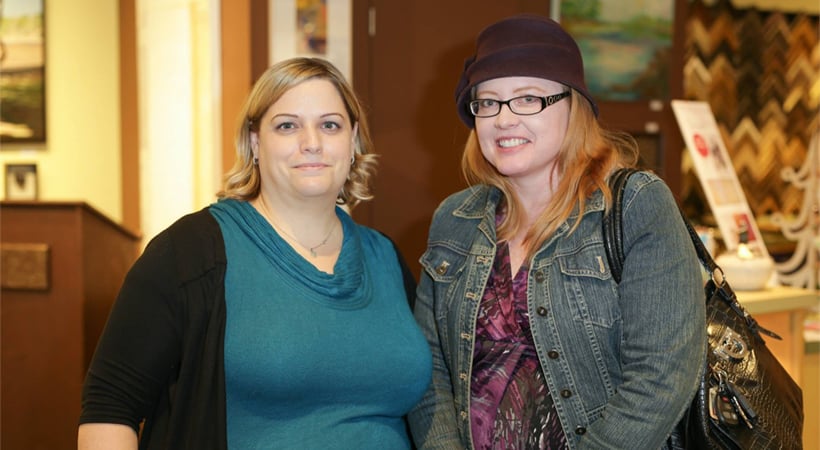
Palimpsest Press publisher Aimée Parent Dunn (left) and Palimpsest founder Dawn Kresan at a Pillette Village Reading Series event in Windsor, Ontario, November 2014. (Nancy Johns)
Palimpsest Press publisher Aimée Parent Dunn jokes that her Windsor-based small press is too small to fail.
This year, the “small but mighty” press marks 25 years of operation, and Dunn – who is not eager to take the spotlight – is marking the anniversary with a social media campaign designed to highlight the authors who have written the more than 100 titles Palimpsest, and its poetry imprint, Anstruther Books, have published over the last quarter-century.
Dunn hasn’t always been a publisher. A fortuitous meeting with an old friend led to the unexpected opportunity to take over Palimpsest Press.
In 2012, she was laid off from her job in the finance department at the OLG racetrack in Windsor when the racetrack closed. Dunn, who was then 36, decided to look for more than simply another job, and enrolled in the publishing program at Toronto Metropolitan University.
In the first few months of her first course, Dunn had an assignment to interview a publisher. She asked Palimpsest Press publisher Dawn Kresan if she would mind meeting to talk about publishing.
She went to the meeting expecting to ask Kresan, with whom she attended high school and university, questions for her assignment. But Kresan, it turned out, had a proposal for her.
After 12 years, Kresan, who is also a poet, was looking to sell the company for health reasons and asked if Dunn would like to buy it.
“My first instinct was no, of course not, that’s crazy,” Dunn remembers. “And then I went home and talked to my husband about it, and he was like, ‘Why not though? You’re literally going to school for it. You would walk in to something that’s already established, that’s already part of core grant funding.’”
And so Dunn decided to jump in with both feet. She and Kresan agreed to a two-year internship, during which she learned as much about Palimpsest and how it worked as she could, even as she continued with her publishing courses at TMU.
Dunn stepped into the role of publisher in January 2014, and hasn’t looked back. Since she took over, Palimpsest has grown its list from four titles a year to at least 10, half of them poetry titles under the Anstruther Press imprint, which is overseen by poetry editor and poet Jim Johnstone.
The core Palimpsest team is rounded out by in-house designer Ellie Hastings, with River Street Writing providing publicity support, and freelance editors as needed. Sales are handled by Canadian Manda Group and distribution by University of Toronto Press Distribution.
“Dawn Kresan really had a vision for this company, and I’m hoping that we’ve stayed true to it: looking to the future while embracing the past,” Dunn says. “I’d be remiss in not acknowledging that what she set up is the only reason we were able to thrive in the years since I’ve taken over.”
Dunn sees Palimpsest’s evolution and growth as a reflection of its name, something that is new and has changed, but still retains a trace of its original form. Kresan started Palimpsest in 2000, initially publishing a literary journal called Kaleidoscope. She moved on to publishing books and chapbooks in 2004, and first applied for funding four years later, as she told poet and author rob mclennan in a 2011 interview for his blog.
Dunn worked to expand the list, putting out more books each year and adding fiction to the lineup, publishing a first novel, Shawna LeMay’s Rumi and the Red Handbag, in 2015. The book sold well: it was in airports across the country and remains part of the core backlist. The book was also a finalist for the 2016 Edmonton Public Library Alberta Readers’ Choice Award.
“That very first fiction title kind of knocked it out of the water for us,” Dunn says.
There have been more successes since. In 2021, when the Governor General’s Literary Awards nominations were announced, Dunn awoke to an inbox overflowing with congratulatory messages, and flowers from Biblioasis.
Palimpsest received three nominations that day: Essex County–based author G. A. Grisenthwaite was shortlisted for the fiction prize for Home Waltz, Tolu Oloruntoba was shortlisted for the poetry prize for The Junta of Happenstance, and Sadiqa de Meijer was shortlisted for the nonfiction prize for alfabet/alphabet: a memoir of a first language. Oloruntoba and de Meijer went on to win. Palimpsest is publishing de Meijer’s next book, a collection of essays, in October.
“Three nominations in one year and then to win two of them was insane, and the following year, Tolu’s book won the last Canadian Griffin prize,” Dunn says. “That obviously was a banner year for us.”
Dunn sees Palimpsest’s continued success as the result, in part, of its size.
“We’re too small to fail,” she says. “There’s not much to take from us. I can manage through hard times.”
The pandemic, for example, didn’t affect the small press the way it impacted some larger independent houses. The team was already virtual, so there was no commercial lease that needed to be paid or emergency government funding applied for. Dunn had switched distributors just before COVID, so she had already received returns from bookstores across the country. Palimpsest Press actually came out of the pandemic with about triple its previous sales numbers, Dunn says.
Another factor in the press’s resilience, Dunn believes, is its approach to the author-publisher relationship: Palimpsest is committed to working with each author to ensure the final product is something they are proud to sell. The press has a mandate to work with authors with disabilities, and part of that commitment includes working within the parameters of each author’s ability to participate in promotional events for their book.
“The people that come, they stay; they want to be re-published with us,” Dunn says.
As she looks ahead to the future, Dunn hopes the press continues to grow. A bricksand-mortar store, ideally in Windsor’s Riverside neighbourhood, where readers can come in and experience all the books first-hand, is one goal.
But most importantly, Dunn wants to ensure that readers are always able to find Palimpsest’s books.
“I don’t want our titles to ever go out of print. Books are so evergreen,” she says. “I want our stuff to stay in print for the authors, so that people can always get their books.”




 Contact us via email