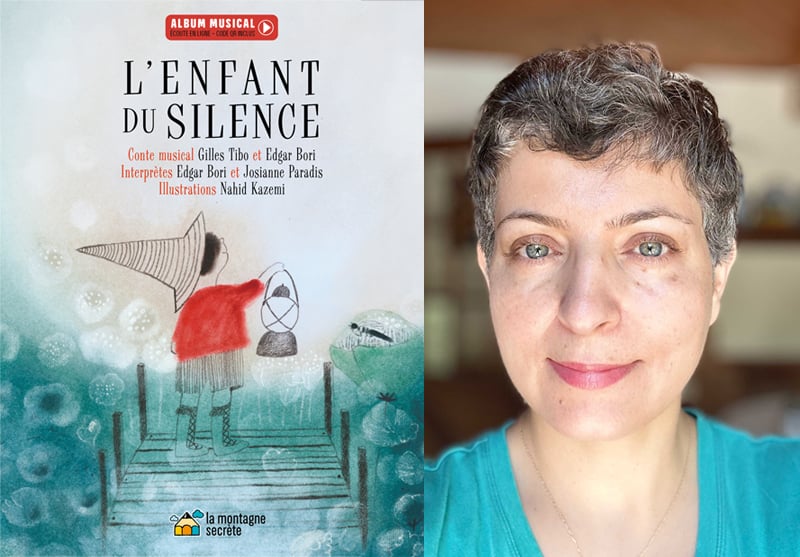
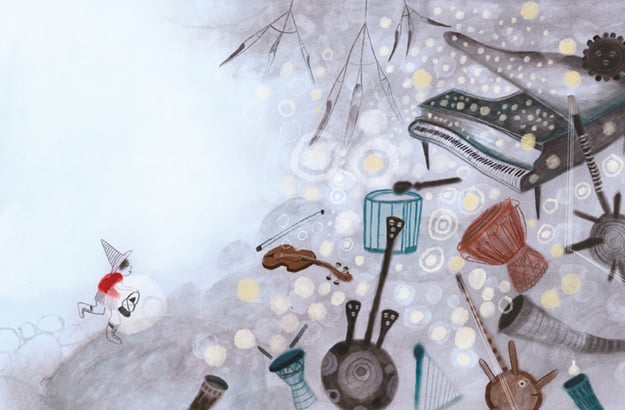
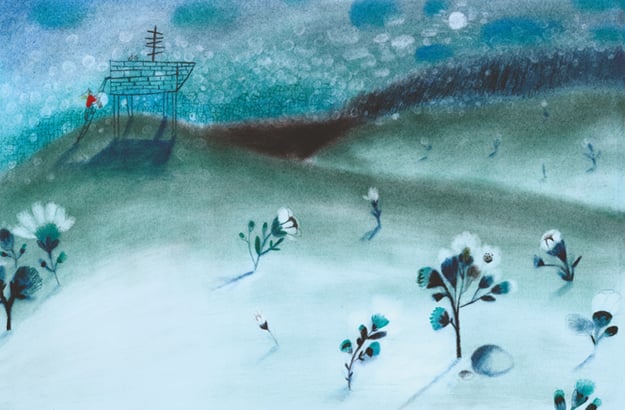
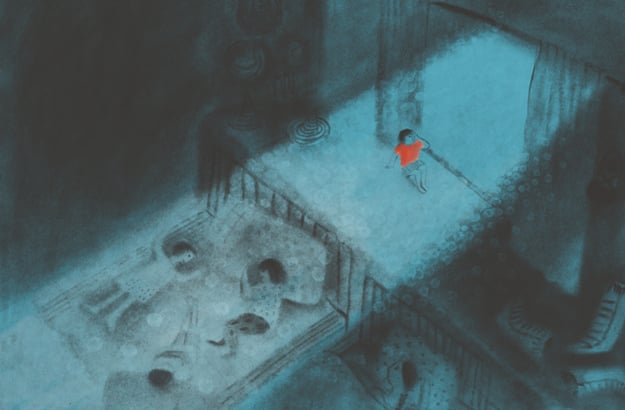
Nahid Kazemi is an artist, graphic designer, and illustrator with a master’s degree in painting. She has published more than 70 books, including The Sour Cherry Tree, which won the Governor General’s Literary Award for young people’s literature for illustration in 2022. Her latest picture book, L’enfant du silence (La Montagne secrète, out now), with an English edition expected in 2027, explores the many treasures that silence holds.


What sparked your interest in illustration?
It was the love of literature, which came from growing up in a family very familiar with the stories and the art of Iran.
Who or what has been a major influence on your illustrating style?
In Iran, I was trying to find my voice. I illustrated a lot of books while I was there, and for every picture book that I created, I tried to experiment with something new. But I had limitations and restrictions there that didn’t allow me to find my true self. It was when I immigrated to Canada about 12 years ago and started to work in a free country that I discovered my style. I’m still learning, still discovering, still growing, but I found my style here in Canada.
Did you know from the start that you wanted to illustrate children’s books?
No, I didn’t. I considered myself more of a painter. The first time I was asked to illustrate a story, I told my editor that I don’t consider myself a children’s picture book illustrator. He’s the one who said, “I think it’s the same. Someone who knows how to draw can also illustrate.” He was right. I understood that when you know how to draw, how to design, you can find your way in any form of illustration.
When a project such as L’enfant du silence crosses your desk, where do you begin?
I read the story. Once I get familiar with the characters, I’ll draw them a lot. Then comes the location, and I’ll sketch the characters in the location. I’ll seek out references to find new ideas.
How long does it take to illustrate a book?
It depends on the project. For me, the beginning is the toughest part. As soon as I get the final form of the book, the style for the character, for the location, for the atmosphere, I can create it in two or three months. If I connect with the story and the characters, I can work very quickly.
What is your medium of choice?
When I was in Iran, I worked with watercolour and pencil. I really loved watercolour’s transparency and enhancing it with colour pencils. But, when I came to Canada, I discovered pigment. It gives me the same transparency, and I can erase it. Since then, I’ve been using pigment and pastel.
Are there any materials you haven’t tried that you would like to try in the future?
I love trying different materials. Honestly, I don’t limit myself. I like Japanese ink, and drawing with Japanese calligraphy brushes.
What do you do to nurture your passion for illustration?
Nature, for me, is the best teacher. I love to walk in nature and see the colour palette, texture, and forms. And sometimes, when I walk in nature, I can see how prominent illustrators have used nature in their work.
What do you hope young readers will take away from L’enfant du silence?
L’enfant du silence is about the beauty of silence. It reminds me of when I was a kid in Iran. In the summer, we would sleep in the yard, and watch the sky. I saw the beauty of darkness and silence. There’s magic in silence.
If you could illustrate any classic children’s book, which would it be?
Pippi Longstocking, I love her character.
This interview has been edited and condensed.
Read Q+As with Lauren Tamaki and Miki Sato.




 Contact us via email